Tidbits

Reminder: If you’re reading this in your email, you have to go to dpauthor.com and click on the Speaking of Which tab in order to view the actual blog post with the featured image.


Dear Reader:

I wanted to provide a few updates that may be of interest to some of you.

— You’ll find information about the 2025 Conrad M. Hall Symposium for Virginia History here. The focus will be on the important role Virginia played in the Revolution. It will be held October 4 at the Virginia Museum of History and Culture, 428 N. Arthur Ashe Boulevard, Richmond, VA, and include several Revolutionary War-related presentations.

— Here’s a link to a notice about the upcoming conference sponsored by the Shenandoah Valley Battlefields National Historic District, “Forging Independence: The Revolutionary War’s Early Years,” to be held at the DoubleTree, Front Royal, VA on February 20-021, 2026.

— Any Rev War buff (nerd, geek, nut, maven, etc.) worthy of that species knows about Rick Atkinson’s latest creation, The Fate of the Day (the second volume in his trilogy on the War of Independence), but I’d like to call attention—for the benefit of anyone who’s unfamiliar with it—to John Maass’s new book, From Trenton to Yorktown: Turning Points of the Revolutionary War (Osprey Publishing, 2025). The author of several books on American military history, John is a historian with the National Museum of the United States Army and holds a doctorate in early American history from The Ohio State University. I wrote the following about his latest work on the book’s Amazon page:

Thanks to historian John Maass, readers—in particular, aficionados of our Revolutionary struggle specifically or military history more generally—can now feast on a splendid analysis of the most pivotal military events in the War of Independence: the Continental Army’s victories at Trenton and Princeton, the Saratoga campaign, the Valley Forge encampment, the Battle of Guilford Courthouse, and the siege of Yorktown. In this concise and lucid chronicle, the author lays out an illuminating and persuasive case for why and how these developments profoundly altered the course of the conflict and paved the road to victory for the Patriot insurgency. A book like this merits a wide readership, especially during our collective immersion in the semiquincentennial of American independence. John Maass’s newest literary effort is highly recommended.

— The most recent blurb received for my new book, Winning the Ten Crucial Days, is as follows:

“As a professional historian with a deep interest in regional history, I found that David Price’s book transports readers, both professional historians and the interested non-academic, to the 1776-77 winter action in the Delaware River Valley. The contours of the region, in terms of the topography, the people, and the major characters, are all brought to life. Price captures the dynamic of the ‘Ten Crucial Days’ as if he were an eyewitness relating those events.”
– JAMES E. HIGGINS, Ph.D., Executive Director, Lehigh Valley Heritage Museum/Lehigh County Historical Society and author of The Health of the Commonwealth

Happy reading!


Cutting Back

Reminder: If you’re reading this in your email, you have to go to dpauthor.com and click on the Speaking of Which tab in order to view the actual blog post with the featured image.


Dear Reader:

I wanted to let you know that, going forward, I plan to limit my blogging to providing informational links that may be of interest to others in regard to the Revolution and Founding Era (including my own efforts), rather than crafting original substantive content about such subject matter. I’ve been doing the latter since the inception of this website in August 2020; and to be honest, at this point, the motivation to continue that effort is simply not there. That said, I will always like to write, so we’ll see what else can be done to scratch a persistent itch.

To be clear, this is not a total shutdown, but certainly a retrenchment. Please accept my deepest thanks for tuning into this platform and my best wishes in your pursuit of what I have been trying to provide for the past five years—engaging, informed, and myth-busting reading about the people, places, and events that defined young America’s exploratory path. Frankly, the relative paucity of reader feedback has made it difficult for me to judge how successful the effort was (or not), but then again, maybe that’s my answer.


And in case you’re interested .  .  .

— My new book, Winning the Ten Crucial Days, is reviewed by Kelsey DeFord in the Journal of the American Revolution (JAR) here.

— Also, an article of mine, “John Haslet: Service and Sacrifice in the Revolution,” will appear in the Spring/Summer Issue of The Journal of America’s Military Past, the scholarly, peer-reviewed publication of the Council on America’s Military Past (CAMP), which contains in-depth monographs on military history. The narrative is a spinoff from my third book, John Haslet’s World. You can’t access it electronically unless you’re a CAMP member; however, if you’d like to see the article, shoot me a request at dpauthor64@gmail.com, and I’ll send you a copy once the issue is published.

That’s it for now. Enjoy the rest of your summer.

dp

More about Lemuel Haynes

Reminder: If you’re reading this in your email, you have to go to dpauthor.com and click on the Speaking of Which tab in order to view the actual blog post with the featured image.


Dear Reader:

If you’re interested, the audio of my recent interview by historian Brady Crytzer, host of Dispatches, the podcast of the Journal of the American Revolution, can be heard on the Dispatches website (E300). If focuses on my last JAR article: Lemuel Haynes: An Abolitionist Voice in the Revolution.

If you’d prefer the video version of this interview, you can watch it on the new JAR YouTube channel.


Also: The Benjamin Cooper Tavern—built in 1734 and one of the oldest standing buildings in Camden, NJ—will undergo a $4-million restoration to preserve the building and transform it into the American Revolution Museum of Southern New Jersey. You can read more here.


Stay cool!

Let’s Review

Reminder: If you’re reading this in your email, you have to go to dpauthor.com and click on the Speaking of Which tab in order to view the actual blog post with the featured image.


Dear Reader:

If you’ve read, or are reading, my latest book, Winning the Ten Crucial Days: The Keys to Victory in George Washington’s Legendary Winter Campaign (Brookline Books, 2025), I thank you for diving into those pages. I hope you’ve found it informative, engaging, and thought-provoking, and perhaps even (as Richard J. Kane, Chairman of the Swan Historical Foundation, put it) “an important, insightful, and distinctive companion to the many narratives available on this campaign.”

Your feedback is very important to me, because frankly I believe it’s the best gauge I have of whether it makes sense for me to continue pounding the keyboard in the manner I’ve been doing for the last several years. So if you have a moment, I’d love to hear your thoughts, either by emailing me at dpauthor64@gmail.com or, better yet, sharing your comments with fellow history enthusiasts on the book’s Amazon page. In the latter case, a brief review will help other readers discover this unorthodox account of one of the most storied military enterprises the world has ever known and keep the conversation going. I would truly appreciate it!

Thank you for your consideration, and here’s hoping you have a wonderful summer.

Oh yeah, enjoy our 249th Independence Day.

Best regards,

dp

P.S. My thanks to Jennifer Martin, Executive Director of the Friends of Washington Crossing Park, who provided the inspiration for this post in a recent email. In case you’re interested, I’ve included an excerpt on my Contact page.


82. An Uphill Struggle for Great Britain

Reminder: If you’re reading this in your email, you have to go to dpauthor.com and click on the Speaking of Which tab in order to view the actual blog post with the featured image.


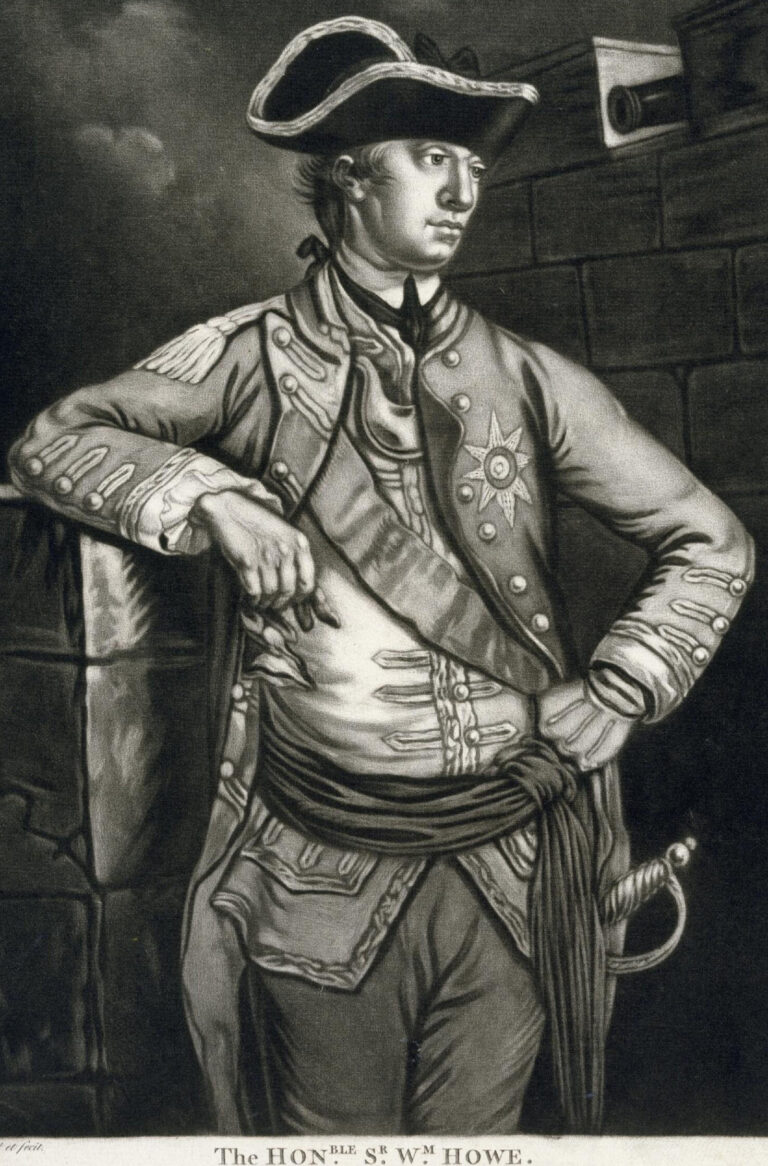
The image displayed above is a work by Richard Purcell, entitled The Honorable Sir William Howe from 1777 (Anne S. K. Brown Military History Collection, Brown University Library), which shows His Lordship wearing the Order of the Bath awarded for his victory at the battle of Long Island (otherwise known as the battle of Brooklyn) on August 27, 1776. Although he was clearly an able and personally courageous officer, Howe exhibited an unimaginative and cautious leadership style as commander of the British army in America from 1775 to 1778. He failed to deliver a knockout blow against the rebel army in 1776 and allowed Washington an opportunity to strike at the Hessian contingent in Trenton, the most vulnerable in a chain of overextended outposts in which Howe deployed his troops for the winter of 1776-77. Sir William would be subjected to intense criticism that led him to call for a parliamentary committee of inquiry so as to vindicate his conduct in America, but the committee adjourned without reaching a conclusion.

The cautious tactics pursued by Howe may have very well stemmed, at least in part, from his experience at the battle of Bunker Hill or (actually) Breed’s Hill on June 17, 1775—250 years ago next week. And that, in turn, may have significantly impacted whatever hopes the British had of scoring a quick knockout blow against the Revolutionary enterprise in 1776, which was arguably their best chance to win the war.

The preservation of his army against what Howe perceived as an unnecessary hazard seems to have been paramount in his thinking and that logic was based, at least in part, on very painful personal experience. This was perhaps the psychological residue of his having been present at the bloodbath sustained by the crown’s soldiers at Breed’s Hill, for we know that Howe was horrified by what he saw there. His side carried the field but suffered more than a thousand casualties—some 40 percent of the British force—and all 12 of his aides were shot around him, only one of whom survived. In his understandably despondent reflection on “this unhappy day,” a distressed Howe wrote, “when I look to the consequences of it, in the loss of so many brave officers, I do it with horror. The success is too dearly bought.” He later explained his failure to launch a frontal assault on the American fortifications at Brooklyn Heights immediately following the battle at Long Island by asserting the logic of a more risk-averse plan of action: a siege that would accomplish the same purpose but with far fewer casualties. As he put it, “the lines must have been ours at a cheap rate by regular approaches.” Whatever his motivation, this go-slow approach gave the Patriot troops the opportunity they desperately needed to evacuate Brooklyn Heights two nights after the battle and escape across the East River to the safety (albeit temporary) of Manhattan Island.

Whether because of his memory of Breed’s Hill or a desire to defeat the rebels with as little bloodshed as possible so as to bring about a relatively harmonious reconciliation between the two sides, Howe, throughout the New York campaign, eschewed the kind of scorched-earth policy—a concerted effort to destroy Washington’s army and lay waste to the Manhattan and Westchester countryside—that may have been required to crush the rebellion. And by doing so, he passed up an opportunity to shatter the confidence of the insurgents and thereby undermine their resolution to continue resisting the invaders. With the notable exception of the battle of White Plains on October 28, 1776, Howe continued his policy of avoiding frontal assaults and instead relying on flanking movements against the Americans, as he had done at Long Island and would repeat at the battle of Brandywine Creek on September 11, 1777. On both occasions, he achieved a tactical victory but failed in his objective of crushing Washington’s force. These were probably the two biggest engagements of the war in terms of the number of troops involved, and in both cases Howe’s foe eluded the Briton’s desire for a victory that would eliminate the opposing army as an effective fighting force and thereby quash the rebellion. In short, his failure presaged Britain’s ultimate debacle in this struggle. And Howe.


The content of this post is, in part, adapted from my new book, Winning the Ten Crucial Days.

And speaking of which, here’s the latest review to come in:

“David Price joins the ranks of recent scholars contributing to the study of the battles of Trenton and Princeton. In examining the keys to Washington’s winter victories, Price goes beyond a standard campaign narrative. His focus is instead thematic, exploring how five factors— leadership, geography, weather, artillery, and contingency—all influenced the campaign. This new approach is well worth the read.”
—JOHN R. MAASS, Ph.D., historian with the National Museum of the United States Army and author of From Trenton to Yorktown: Turning Points of the Revolutionary War

81. Lemuel Haynes

Reminder: If you’re reading this in your email, you have to go to dpauthor.com and click on the Speaking of Which tab in order to view the actual blog post with the featured image.


For those interested, I wanted to provide a link to an article of mine, which was just published in the Journal of the American Revolution, about Lemuel Haynes (1753-1833, pictured above), a Continental Army soldier who became the first Black minister ordained by a mainstream Protestant denomination. In the context of the Revolution, he is best known for his 1776 essay that argued for abolishing slavery—”Liberty Further Extended: Or Free Thoughts on the Illegality of Slave-keeping”—and which served as a source of inspiration to not only abolitionists but women’s rights advocates as well. Among the honors accorded Haynes was an honorary Master of Arts degree from Middlebury College at its second commencement in 1804, making him the first African American to receive an honorary degree. In 1975, the last home in which he lived—in South Granville, NY—was designated a National Historic Landmark.

You can read more here.


Miscellanea

Reminder: If you’re reading this in your email, you have to go to dpauthor.com and click on the Speaking of Which tab in order to view the actual blog post with the featured image.


FYI, here’s a tidbit about the challenges facing one Rev War site—the Bennington Battle Monument in Vermont—that arrived in an email courtesy of John Maass, historian at the National Museum of the U.S. Army: take a look if you’re interested. John also passed along a link to a Smithsonian Magazine article about the early stages of the American rebellion in the South, which can be viewed here.


On June 19, the National Museum of the U.S. Army will host an author talk with historian Gary Ecelbarger about his new book, George Washington’s Momentous Year: Twelve Months that Transformed the Revolution. The event starts at 7 PM ET, and is free.
The direct Zoom link is: https://www.zoomgov.com/j/1611147630

Here’s a link to information about a conference on September 14-16 in Washington, DC, sponsored by the Jack Miller Center — “The American Revolution and Its Legacies from 1776 to Today.”


I’d like anyone who’s thinking about buying my new book—Winning the Tern Crucial Days—to know that, although it’s available wherever books are sold, if you’d like a signed copy AND want to support one of the most hallowed historic sites in North America, you can do so online through the gift shop at Washington Crossing Historic Park here (and nowhere else). FWIW, I’ll be speaking about the book as part of the park’s July 4 event — at 2 and again at 4 pm in the Visitor Center auditorium.


For your consideration  .  .  .

I’m always appreciative (as well I should be) when someone compliments me on one of my books; however, I would like to make a humble but earnest appeal to readers of that persuasion to share your sentiments with others online. In particular, for anyone who may be favorably impressed by the new book (or, as we say at Washington Crossing, if it floats your boat), I hope you’ll consider leaving a brief comment on Amazon—even just a sentence or two—BUT only if you honestly believe it deserves 5 stars. Quite frankly, those reviews are the mother’s milk of recognition for non-brand-name authors, so that would be very much appreciated—and many thanks in advance.

Please note: These remarks are not directed at the several readers who have graciously offered endorsement quotes for the book that are posted on this website, as well as by Brookline Books and Amazon. I am very grateful for your support!!


And Finally  .  .  .

Memorial Day being close at hand, I’ll leave you with this snippet from Thomas Paine:

“Those who expect to reap the blessings of freedom must … undergo the fatigue of supporting it.” (The American Crisis IV, September 12, 1777)


80. The Letter That Started a War

Reminder: If you’re reading this in your email, you have to go to dpauthor.com and click on the Speaking of Which tab in order to view the actual blog post with the featured image.


You may have never heard of Discover Magazine magazine, and neither had I until very recently; however, this article made its way into the spring issue and I thought you might enjoy it. (My marching orders were to limit this to two pages, but hopefully brevity is not its only virtue.)

This piece actually ensued from something I wrote for the Journal of the American Revolution (JAR) in response to a question posed to contributors by the editors: What is the most underrated event that occurred in 1775, and why should it get more attention? My response apparently piqued the interest of the magazine’s co-publisher and co-founder, Cynthia Baudendistel—so my thanks to JAR.

And BTW, you can check out the magazine’s Battle Road Official Commemorative book, Discover the Battle Road, here.


For anyone who may have been thinking about purchasing my newest hardcover creation, here are the latest reviews to come in:

“I found Winning the Ten Crucial Days to be a fascinating and insightful new look at this critical period of history. The idea of leadership involving theatrical gestures is spot on. David Price’s treatment of Washington is fair and balanced with enlightening nuance—as with Joseph Reed and Edward Hand, both so important to this story, and John Cadwalader and Henry Knox. Price’s emphasis on the complexity of all the factors is well taken, luck included. It brought to mind the old dictum, ‘Armchair generals talk about battles, real generals talk about logistics.’ Things like geography, weather, supplies, etc. often make the difference.”
— JACK KELLY, author of God Save Benedict Arnold, Band of Giants, and other books on the Revolutionary War and early America 
 

And from the other side of the pond  .  .  .

“This book offers an interesting approach to analysing Washington’s winter campaign that will best be appreciated by readers who already have some familiarity with the battles from more conventional military histories.… Contains much useful information and is well worth reading.”
MINIATURE WARGAMES magazine, published in Great Britain since 1983


And speaking of the other side of the pond  .  .  .

At the initiative of Aaron Callan, Editor of The Bann Disc (since 1994 the annually published journal of the Coleraine Historical Society in Northern Ireland), I’ve conjured up a draft of an article about John Haslet and the Delaware Continental Regiment of 1776 for a special edition of that periodical. (Haslet grew up in the area.) This edition, to be released next year, will commemorate the 250th anniversary of American independence and the historical connection between Ulster and the American Revolution. (BTW, the Bann disc is an Iron Age bronze artifact discovered in the River Bann near Coleraine in 1939. Irish I could think of something clever to say about that—but obviously cannot. On the other hand, if the article was very long—which it’s not—you could say it has a lot of Bann width.)


Finally, for anyone interested in buying commemorative American Revolution stamps from the USPS, you’ll find more information about that here.

79. April 19

Reminder: If you’re reading this in your email, you have to go to dpauthor.com and click on the Speaking of Which tab in order to view the actual blog post with the featured image.


Well, it’s almost here—the 250th anniversary of the date that armed combat erupted in a significant way between British troops occupying Boston and the provincial militia, which triggered the longest war in American history prior to Vietnam. At that time, both sides probably shared the same expectant assumption that hostilities were unavoidable in the absence of any change in the mother country’s colonial policy or the attitude of Whig-minded insurrectionists among the body politic—and now, at last, the powder keg had exploded at Lexington and Concord. The wait was over.

In his diary, Frederick MacKenzie, the son of a Dublin merchant who arrived in Boston in 1774 as a lieutenant in the British army (and would be promoted to captain in the fall of 1775), recorded his firsthand observations about the events and dismal outcome of the ill-fated and bloody expedition by his redcoated countrymen, as ordered by General Thomas Gage, into the Massachusetts countryside on April 19, 1775 to secure military supplies gathered by the insurgents. Here are some excerpts from the lieutenant’s entries in the immediate aftermath of the opening clash:

April 19—During the whole of the march from Lexington [as the British withdrew to Boston after they had exchanged shots with the militia at Lexington and Concord], the rebels kept an incessant irregular fire from all points at the column, which was the more galling as our flanking parties, which at first were placed at sufficient distances to cover the march of it, were at last, from the different obstructions they occasionally met with, obliged to keep almost close to it. Our men had very few opportunities of getting good shots at the rebels, as they hardly ever fired but under cover of a stone wall, from behind a tree, or out of a house; and the moment they had fired, they lay down out of sight until they had loaded again or the column had passed…. Many houses were plundered by the soldiers, notwithstanding the efforts of the officers to prevent it. I have no doubt this inflamed the rebels, and made many of them follow us farther than they would otherwise have done.

April 20—It is conceived by many that the expedition to Concord for the destruction of the military stores, which it is said were deposited there in considerable quantities, might have been conducted with greater secrecy, and been effected without the loss which ensued and the consequences which must now inevitably follow….

There was a general muster of all the neighboring militia only the day before (whether by accident, or in consequence of the general’s intention is not certain, but most probably the latter) so that every man was in a state of preparation and equipment. This should have been known, because if their meeting was not on purpose to oppose the troops, there was hardly time for them to disperse and return to their several homes. I believe the fact is that General Gage was not only much deceived with respect to the quantity of military stores said to be collected at Concord but had no conception the rebels would have opposed the king’s troops in the manner they did. But the temper of the people, the preparations they had been making all the winter to oppose the troops should they move out of Boston with hostile intentions, and above all their declared resolution to do so made it evident to most persons that opposition would be made on any attempt to destroy stores and ammunition which they had avowedly collected for the defense of the province….

The troops [are] ordered to lay dressed in their barracks this night.

April 21—The town is now surrounded by armed rebels, who have intercepted all communication with the country.

This was the beginning of the American siege of Boston that would last almost a year and end only when His Majesty’s forces evacuated the city on March 17, 1776—never to return.

On another April 19—exactly eight years later—the pamphleteer Thomas Paine, author of America’s first bestselling publication Common Sense, released the last of his Crisis series, wherein he ruminated about the outcome of the American rebellion. He termed it “a revolution, which to the end of time, must be an honor to the age that accomplished it, and which has contributed more to enlighten the world, and diffuse a spirit of freedom and liberality among mankind, than any human event (if this may be called one) that ever preceded it.”

Sources:

“Frederick MacKenzie: Diary, April 18-21, 1775,” in The American Revolution: Writings from the War of Independence, ed. John Rhodehamel (The Library of America, 2001), 5-18.

Thomas Paine, “The Last Crisis, Number XVIII,” April 19, 1783, in Thomas Paine, Collected Writings, ed. Eric Foner (The Library of America, 1955), 348-354.

78. So Unexpected A Book

Reminder: If you’re reading this in your email, you have to go to dpauthor.com and click on the Speaking of Which tab in order to view the actual blog post with the featured image.


Hi All –

Allow me to introduce Jeffrey Evan Brooks and his new book, So Unexpected A Moment: A Novel of the Revolutionary War, which yours truly had the pleasure of assisting with in terms of reviewing and commenting on the manuscript. To be sure, I found its narrative to be at variance with my interpretive understanding on certain points, but, hey, it IS a novel and I enjoyed the read very much—so much so that I asked Jeff if he would agree to be interviewed for one of my blog posts. He has graciously consented to do so.

Jeff, tell us about your background and how and why you came to write this book.
I am a lifelong student and teacher of history. As a boy, I devoured every history book I could lay my hands on. My parents took me on wonderful road trips, visiting historical sites all across the country. Now that I’m an adult, I buy far too many history books to ever read. And my chosen vocation (I wouldn’t call it a “job”) is to teach American history to 8th graders. History is my life.
As to why I came to write this particular book, I have always found the story of the “Ten Crucial Days” irresistible. It’s simply so full of drama and great characters, with the fate of the nation hanging in the balance. It’s a historical event crying out to be turned into a good historical-fiction novel.

Give us a quick summary of the book’s contents.
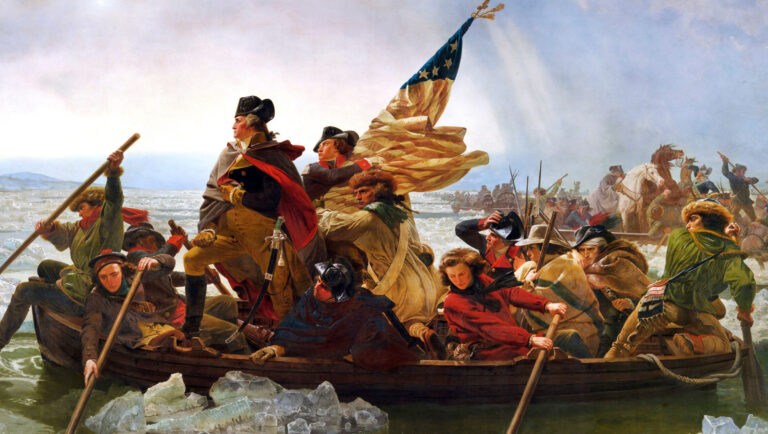
The novel is a retelling of the Ten Crucial Days—the Delaware River crossing, the first Battle of Trenton, the critical decisions made by both sides immediately afterwards, the much-neglected Battle of Assunpink Creek (or second Trenton), and finally the Battle of Princeton. Everyone has seen the famous Leutze painting of the Delaware crossing, of course, but as I like to tell my students, the true story is infinitely richer and more dramatic than its depiction in art. There is no need to dramatize it, but what really happened is a more vivid and astonishing story than anything imagined by the best fictional novelist.
But it’s not just a dramatic military tale. The Revolutionary period was a time of new questions about human freedom. If America was going to be an independent nation, what kind of nation was it going to be? So as the protagonists struggle through their various adventures, they find themselves debating with themselves and with one another exactly what the war is really about.

How did the experience of writing this book compare with your previous book, which is an alternate history novel of the Civil War?
The first third of my first novel, Shattered Nation, was genuine historical fiction. It was only with the “point of divergence” that it became alternate history. This book, on the other hand, is straight-up historical fiction. So I did not have the freedom to imagine events unfolding in my own way. I thought this would make the novel easier to write, but I found it was actually much more difficult. I had to do much more intensive research.
And as far as primary source material, the Revolutionary War is not as rich a time period as the Civil War era.

What was most challenging for you in crafting this novel?
As with any historical fiction, there is the problem of accuracy. The needs of the novelist are different from the needs of the nonfiction writer. Sometimes, telling the story with perfect historical accuracy might actually leave the reader more confused than they otherwise would have been. I wanted to tell the true story of the Ten Crucial Days, but not to get so bogged down in details as to leave the reader frustrated and confused. So certain things have gone unmentioned or been simplified, but only in cases so minor as not to make any real difference.
Almost everything depicted is, as nearly as possible as we can determine, what really happened, or at least what could have happened. The adventures of John Mott are largely conjectural, as I needed a vantage point for the reader to see certain events, such as Edward’s Hand’s brilliant delaying action on January 2, 1777. The only point in the novel where I really allowed my imagination to run wild was the story of how Robert Morris obtained the money needed by Washington on December 30, 1776 to pay a bonus to those soldiers who agreed to remain with the army when their enlistments expired, but that story is so steeped in legend that I felt it a worthwhile indulgence.
I decided earlier on that, while the story obviously revolves around Washington, I was not going to use him as a perspective character. I’m not so arrogant as to think I could get inside that man’s head. So it was a challenge to write a novel in which the reader never sees the events through the eyes of the most important person.

What sources of information proved most helpful to you in your research?
The most fun I had doing research for the book was using the free and easily accessible Founders Online, the National Archives’ online database of the writings of Washington and others. Reading the letters and official orders issued by Washington during this period, some of which are included verbatim in the novel, is simply thrilling.
Of the numerous books written about the crossing of the Delaware and the battles at Trenton and Princeton, by far the best is Washington’s Crossing by David Hackett Fischer. It’s a stupendous feat of historical writing and fully deserved its Pulitzer Prize. Another very useful source was The Winter Soldiers by the late, great Richard M. Ketchum. I read a number of biographies, including those of Nathanael Greene, Benjamin Rush, Henry Knox, Charles Cornwallis, and others.
And, of course, your wonderful books were a great help to me, especially your book on John Haslet. [Note to the reader: Let the record reflect that no bribery was involved here—at least none that can be proven.]

Did writing this book change your perception of the events or people about whom you wrote and, if so, how?
I felt I already knew a lot about these events when I started to write the novel. But as I wrote, I found myself more and more in awe of these amazing men and what they went through during those ten days. Needless to say, our nation was not created by soft people. It makes me wonder if today’s Americans would have what it takes to match the feats of the founding generation.
At the same time, I found myself admiring the British characters, who were not the cardboard cutout villains Americans sometimes imagine (as, for example, in Mel Gibson’s movie “The Patriot”). General Cornwallis and Lieutenant Colonel Charles Mawhood were great and honorable men, fighting for what they thought was right. And they had a sense of decorum and dignity that has almost entirely vanished in our time and which we would do well to try to restore.

What would you most like readers to take away from reading the book?
This book is an expression of my gratitude and appreciation for the people who created this country. We take our freedoms for granted, so much so that I have 8th graders express astonishment that there are people in the world who don’t have freedom of speech, freedom of religion, the right to vote, the right to a fair trial, and all the rest. We too easily forget that those who came before us struggled and suffered, and many gave their lives, to win those freedoms for us. David McCullough once commented that not bothering to learn about the founding generation is a form of ingratitude and that ingratitude is a shabby personal quality. I entirely agree.

Do you have another writing project in mind?
I am thinking of writing a novel about Operation Dragoon, the little-known invasion of southern France during World War II.

Thanks, Jeff. Good luck with the new book and your next undertaking.

And if readers want to check out your Amazon page, they can do so here.


BTW, in case anyone is wondering, the official release date for my new book, Winning the Ten Crucial Days, is April 15, although signed copies are currently available in the gift shop at Washington Crossing Historic Park.